Why Architecture Intelligence, Not Visualization

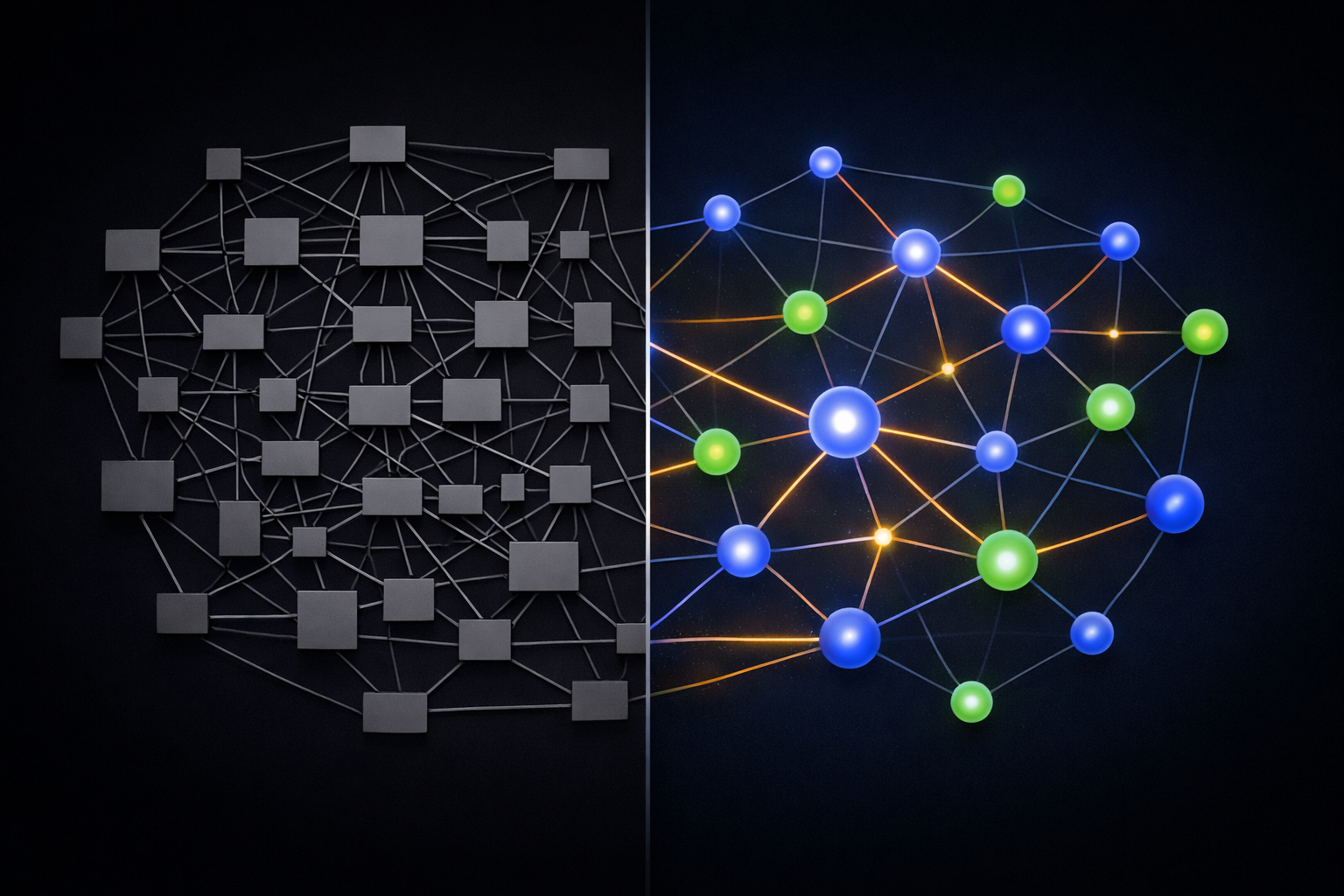
Code is being written faster than it's ever been understood.
AI coding agents — Cursor, Copilot, Devin, Claude Code — are accelerating how fast teams ship. A developer can scaffold a service in an afternoon. A team can generate thousands of lines across multiple repos in a week. The output is real, functional, deployed code.
But here's what hasn't accelerated: understanding what was built.
Every new service, every refactored module, every agent-generated integration adds to the system's complexity. The architecture evolves daily. The architect's understanding of it doesn't — because the tools haven't changed. You're still drawing boxes and lines in the same tools you used five years ago.
The speed gap
We've had a documentation gap for years — architecture diagrams going stale within months. That was manageable when systems evolved slowly. A quarterly update to the C4 model was roughly good enough.
Now systems evolve weekly. Sometimes daily. AI-assisted development means the codebase your team had on Monday isn't the codebase you have on Friday. New dependencies get introduced. Service boundaries shift. Patterns emerge that nobody explicitly decided on — they just appeared because an agent generated code that way.
The documentation gap just became a documentation chasm. And diagrams can't bridge it because diagrams are snapshots. Snapshots of a system that's changing faster than you can draw.
Visualization was built for a slower world
C4, Structurizr, PlantUML, Mermaid, draw.io — these tools all assume the same thing: an architect understands the system and manually models it. The tool's job is to make that model visible.
That assumption worked when architects could keep pace with the rate of change. When you knew every service because you designed it, or at least reviewed the PR that introduced it. When the system evolved through deliberate decisions, not generated code.
In a world where AI agents are shipping code at scale, the architect's bottleneck isn't drawing — it's knowing what to draw. You can't model a system that's evolving faster than you can comprehend it.
The tools need to shift from "help me illustrate what I know" to "help me understand what I don't."
What intelligence means here
Architecture intelligence isn't about adding an LLM to a diagram tool. It's a fundamentally different starting point.
Instead of the architect manually creating a model, the tool ingests real sources — repos, infrastructure configs, documentation, ADRs — and builds a living representation of the system. Instead of displaying a static picture, it answers questions: "What depends on the payment service?" "What changed in the order domain this week?" "Which services were introduced in the last sprint and what do they connect to?"
This matters specifically because of AI-accelerated development. When agents generate code, the generated code has structure, dependencies, and architectural implications — but no recorded intent. Nobody wrote an ADR for the service boundary that Cursor scaffolded. Nobody documented why the agent chose that particular integration pattern.
Architecture intelligence fills this gap. Not by slowing development down, but by keeping understanding current as the system evolves.
The practical difference
A visualization tool shows you the system as it was when someone last updated the model.
An intelligence tool shows you the system as it is — and helps you reason about what it should become.
When your codebase was evolving at human speed, the first was good enough. Now that it's evolving at machine speed, you need the second.